What is a Funnel in Digital Marketing? A Complete Guide

In digital marketing, it’s not enough to get customers to discover your products. The bigger task is to drive potential customers from initial awareness through to being a repeat customer. This is known as the marketing funnel (a.k.a. Funnel in Digital Marketing).
The digital marketing funnel is a concept that maps out the customer’s journey from awareness to conversion and beyond. It’s a way for businesses to grasp how customers engage with the brand throughout these stages and what strategies might motivate them to progress towards a purchase.
A strong funnel needs the right mix of content, SEO, paid campaigns, landing pages and follow-up. That is why it connects directly with NKM Digital’s digital marketing services and our guide on SEO for eCommerce.
This “funnel” is called a funnel because a large number of people can learn about your brand at the top. Along the way, only some of them move on to the next stage until finally converting into customers.
Knowing how the digital marketing funnel works is important to develop successful marketing campaigns, enhance the customer journey and boost sales. Let’s understand what is a marketing funnel, what are the stages, why it is important, and how to optimise each stage of the marketing funnel.
What is a Digital Marketing Funnel?
A digital marketing funnel is a concept that illustrates the journey a customer takes from initial contact with a brand to making a purchase. It outlines the process a potential buyer goes through to purchase a product or service.
The funnel recognises that rather than a person buying a product or service immediately after finding your brand, they need time to learn more and form trust.
The funnel helps marketers:
- Understand customer behavior
- Develop stage-specific content
- Nurture leads effectively
- Improve conversion rates
- Foster lasting relationships
It is a guide to converting visitors to leads, leads to customers and customers to promoters.
Why Is It a Funnel?
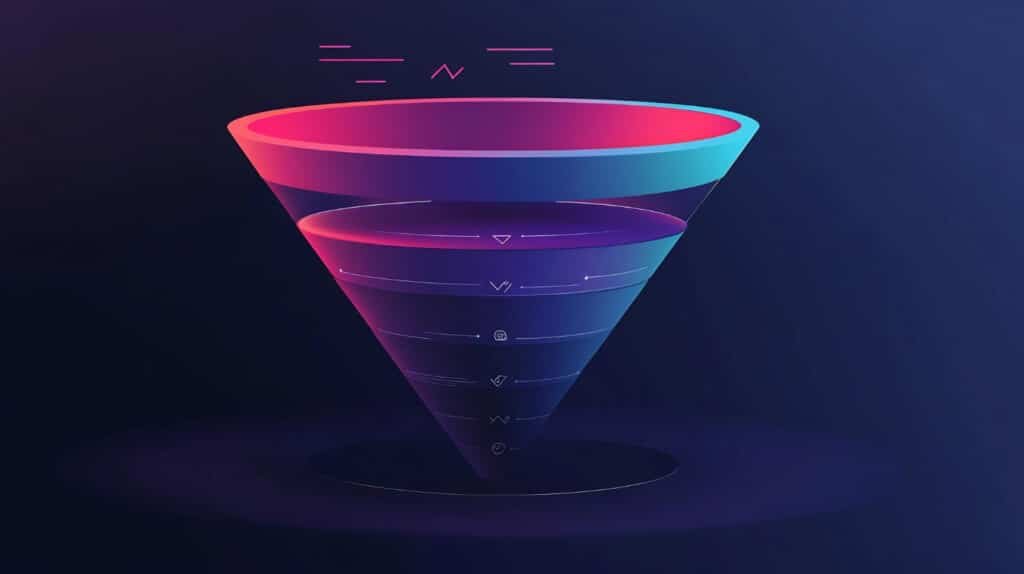
The funnel shape is a metaphor for the way customers interact with your brand.
- Many people learn about your brand.
- In the centre, some become interested and evaluate your products.
- At the bottom, a few of them buy.
- Not all prospects will make it through the funnel. This is perfectly normal. Our objective is to get as many potential customers as possible through the stages.
The Three Stages of the Digital Marketing Funnel
The digital marketing funnel is typically broken up into three main stages:
- Top of the Funnel (TOFU) – Awareness
- Middle of the Funnel (MOFU) – Consideration
- Bottom of the Funnel (BOFU) – Conversion
Let’s take a closer look at each stage.
1. Top of the Funnel (TOFU): Awareness
This is the point where potential customers become aware of your business, product or service. They could be facing a challenge, actively seeking information, or looking for solutions.
They are not ready to make a purchase. They are just looking for information.
Goals at This Stage
- Attract a broad audience
- Build brand awareness
- Educate potential customers
- Generate interest
- Effective TOFU Strategies
- Blog posts
- Social media content
- Educational videos
- Search engine optimization (SEO)
- Infographics
- Podcasts
- Paid advertising
Example
Someone looking for information on “how to increase website traffic” might come across your blog post on SEO. This is the first time they’ve encountered your brand.
2. Middle of the Funnel (MOFU): Consideration Stage
Here, prospects recognise they have a problem and are considering their options. They are weighing up their options, looking for solutions, and determining if your solution fits their requirements.
It’s time for lead nurturing.
Goals at This Stage
- Build trust and credibility
- Demonstrate expertise
- Address objections
- Capture leads
- Effective MOFU Strategies
- Email marketing
- Webinars
- Case studies
- Product comparisons
- E-books and guides
- Free trials or demos
- Retargeting campaigns
Example
A reader of your blog downloads a free SEO checklist or registers for your webinar. They are now considering your solutions and your authority.
3. Bottom of the Funnel (BOFU): Conversion Stage
This is the last stage where prospects are ready to purchase. They’ve compared options and are considering doing business with you.
Your goal during this stage is to unblock and motivate.
Goals at This Stage
- Convert leads into customers
- Reinforce trust
- Highlight value
- Make the purchase process easy
- Effective BOFU Strategies
- Product demos
- Customer testimonials
- Free consultations
- Limited-time offers
- Discounts or incentives
- Strong calls-to-action
- Detailed product pages
Example
A visitor schedules a consultation, upgrades to a premium account or buys a product after reading reviews and prices. Conversion is not the end of the story
The digital marketing funnel is evolving. After the sale, there is more to do.
Retention Stage
- Engage and retain customers through:
- Excellent customer support
- Personalized communication
- Loyalty programs
- Educational resources
- Regular follow-ups
Advocacy Stage
Contented customers may turn into brand ambassadors who:
- Leave positive reviews
- Refer others
- Share your content
- Promote your brand organically
This can help drive higher conversion rates and customer retention.
Why Is the Digital Marketing Funnel Important?
There are many benefits of a good funnel:
- Helps you understand customer behavior
- Enhances targeting and personalization
- Increases lead quality
- Boosts conversion rates
- Enhances customer experience
- Delivers the best return on investment (ROI)
Rather than a blanket approach, you can target customers at the right time.
How to build a digital marketing funnel?
Define Your Target Audience
- Know who your potential customers are, what they need and want.
- Map the Customer Journey
- Understand the steps from discovery to purchase.
- Create Stage-Specific Content
- Create relevant content for each stage.
- Use Marketing Automation
- Automate email campaigns, lead nurturing and follow-ups.
- Analyze and Optimize
- Monitor traffic, click-through rates, conversion rates and cost of acquiring a customer.
What to Track for Funnel Metrics
Different stages of the funnel have different key performance indicators (KPIs).
- TOFU Metrics
- Website traffic
- Social reach
- Impressions
- Engagement rate
- MOFU Metrics
- Lead generation rate
- Email open rate
- Click-through rate
- Content downloads
- BOFU Metrics
- Conversion rate
- Cost per acquisition (CPA)
- Sales revenue
- Return on ad spend (ROAS)
- Retention Metrics
- Customer lifetime value (CLV)
- Repeat purchase rate
- Churn rate
- Net promoter score (NPS)
Common Funnel Mistakes to Avoid
- Focusing only on sales and ignoring awareness
- Using the same message for every stage
- Neglecting lead nurturing
- Poor follow-up strategies
- Ignoring customer retention
- Failing to analyze funnel performance
A successful funnel requires continuous optimization.
Real-World Example of a Digital Marketing Funnel
Imagine an online fitness coaching business.
- A user finds a blog post on weight loss tips (Awareness).
- They download a free meal plan (Consideration).
- They attend a webinar and sign up for a coaching programme (Conversion).
- They renew their subscription and refer friends (Retention and Advocacy).
This is how a funnel turns a stranger into a loyal customer.
Final Thoughts
A digital marketing funnel is a powerful framework that helps businesses understand and guide the customer journey. From attracting attention at the awareness stage to converting leads and building long-term loyalty, each stage plays a vital role in business growth.
By creating targeted strategies for every phase of the funnel, businesses can improve engagement, generate qualified leads, increase conversions, and foster lasting customer relationships.
In today’s competitive digital landscape, understanding and optimizing your marketing funnel is not optional—it is essential for sustainable success.
Need Help Building a Digital Marketing Funnel?
NKM Digital helps brands build websites, campaigns and content systems that move users from awareness to action. If you want a stronger funnel for your business, book a strategy call.
Frequently Asked Questions (FAQs) | Funnel in Digital Marketing
What is a digital marketing funnel?
A digital marketing funnel is a model that represents the journey a customer takes from first discovering your brand to making a purchase and becoming a loyal customer.
What are the stages of a marketing funnel?
The main stages are Awareness, Consideration, and Conversion. Many modern funnels also include Retention and Advocacy.
Why is a marketing funnel important?
It helps businesses understand customer behavior, create targeted strategies, and improve conversions at every stage of the buyer journey.
What is TOFU, MOFU, and BOFU?
TOFU stands for Top of the Funnel (Awareness), MOFU for Middle of the Funnel (Consideration), and BOFU for Bottom of the Funnel (Conversion).
How can I improve my marketing funnel?
You can improve your funnel by understanding your audience, creating relevant content, nurturing leads, optimizing conversions, and analyzing performance regularly.
Contact Us
Ready to elevate
your brand with NKM Digital?
Get in touch with us today!
Let's collaborate and bring your digital vision to life!