Freelancer vs Agency vs DIY Website Builders: Which One Is the Best for a Small Business?

Deciding how to construct your website for business is among the most important decisions you’ll make in the coming year. The website you have created is the heart of your online expansion, your 24×7 salesperson, and the primary site that potential customers go to confirm your credibility. By the end of this article, you will get the complete details about Freelancer vs Agency vs DIY Website Builders and what is right for you.
However, if you begin searching for ways to construct it, you’re instantly confronted by three options:
- Do it yourself (DIY) with the help of platform builders.
- Find a freelancer on a marketplace online.
- Partner with an Professional Digital Agency.
Each option claims to be the most efficient and most economical choice. What is the reality? The most appropriate choice will depend on the stage of your business and your technical proficiency as well as your budget and the amount of time you are worth.
Let’s look at the real pros and cons, as well as some of the hidden truths about each choice so that you can make the best decision for your company’s needs.
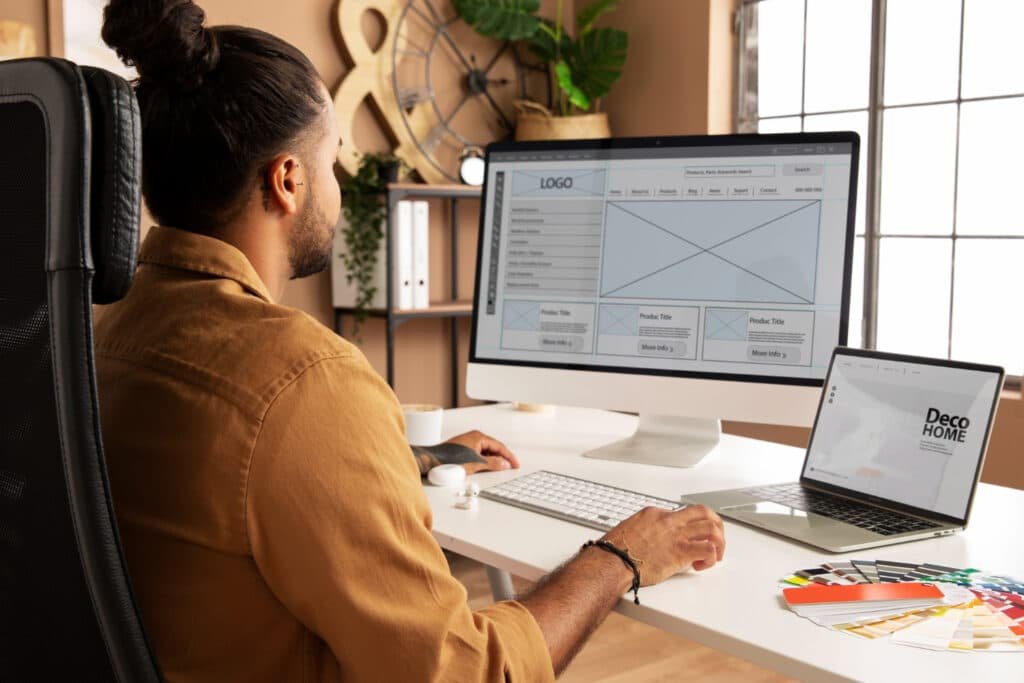
Path 1: The DIY Website Builder (For the Hands-On Founder)
If you’re a solo new entrepreneur and have a very limited budget but have technological skills and the time, creating a website yourself is an ideal option. The latest Content Management Systems (CMS) have seen a significant improvement, and offer strong visual capabilities.
The Catch: Choosing the Right Engine
The DIY approach is only effective if you choose the right platform from the beginning. Many business owners leap into the process without taking a look at the long-term plan, and spend months building their site and then realizing that the platform doesn’t have a vital feature that they require.
Before you commit to a CMS, You must first review your needs:
- WordPress offers complete control and an infinite plugins ecosystem, but will require you to control your own host security and updates to security, as well as daily technical maintenance.
- Webflow / Framer: A great choice for flawless, fluid, responsive web design services. They provide cleaner code structures and super-fast loading speeds, though they come with a steep learning curve for beginners.
- Support Ecosystems: Review the support infrastructure for your platform. If your website goes down, or your form ceases to collect leads from customers on a Friday night, do you have an individual support line, or are you tethered to forums for help in fixing codes?
The trade-off for DIY: Each hour you are trying to fix the layout that is broken or fixing an issue with a plugin or adjusting responsiveness for mobile is a time taken away from handling your customers, enhancing your offerings, and increasing the amount of money you earn. When your time and energy are important, “free” or “cheap” DIY solutions could become extremely expensive.

Path 2: Hiring a Freelancer (For Tight Budgets & Defined Tasks)
The hiring of a freelancer can be the ideal option if you don’t have the desire to deal with technical complexities and don’t wish to learn the basics of programming and have a tight budget.
Avoiding the “Template Trap”
The market for freelancers is huge, and the quality can vary greatly. On one hand there are skilled, highly skilled professionals. On the other hand, the marketplaces are flooded with offers that promise an entire website for just $200.
In our pricing guide, these cheap choices are usually untrue. They don’t create any custom-designed content. Instead, they will purchase templates that are pre-designed and generic or use a free WordPress theme, then copy-paste the text and give it to you.
Since their business model is based on the ability to turn projects around in the shortest amount of time, they don’t have time to properly optimize your website. It is common to have a website that looks good on the surface but has slow loading speeds as well as poor mobile rendering and a lack of SEO base.
Safeguards Before You Hire a Freelancer:
- Examine the Portfolio of their work beyond screenshots: Don’t simply look at photos from their portfolios. Request live links of the websites they have developed. You can open those sites on your phone. Are they responsive? Are the pages loaded instantly?
- Read reviews from independent sources: Check for reliability over time. What happens if the work is “done”, however? You discover bugs a week after.
- Accept the one point of failure: One freelancer is just one person. If they are sick, take a break or have to manage several projects simultaneously, your digital timeline can stall completely.

Path 3: Partnering with an Digital Agency (For Established Growth and Scalability)
If you own a reputable small-to-medium-sized enterprise (SME) or an old-established business moving to the internet, working with a digital agency that is professional is usually the most profitable option.
When you work with an agency, you’re not simply paying for code; you are hiring a multi-disciplinary group dedicated to the growth of your business.
The Power of an All-in-One Team
A well-integrated web presence requires more than just a little development. It requires customized graphic design and clear branding, as well as written copywriting that is targeted towards conversion and stringent technical SEO structure.
If you employ freelancers, you will need to take on the project manager role. You need to locate a graphics designer for your logo, an expert to design your banners for your website and a programmer to code it as well as an SEO expert to improve the site’s performance. If the website loads slowly, the developer blames the designer, the designer blames the host, and you are caught in the middle
An agency takes care of this hassle by coordinating everything under one structure:
- Unified Strategy: Brand strategists ensure you have a logo that is recognizable, color schemes and messages are geared towards your ideal customer.
- Advanced Visual Assets: Proficient designers design banners and website assets that are custom-specifically tailored to the layout of your website.
- Built-in Accountability: The agency is the sole owner of the process and provides the project management tools so that you can concentrate on managing your business.
How to Evaluate an Agency
Before signing a contract, be sure to look past the appearance of the presentation. Check out their case studies and customer reviews. A great agency shouldn’t just show you pretty designs; they should be able to describe how their web design services for small business have driven conversions, increased visibility on search engines, and solved real business problems for their clients.
Related Post: 5 Logo Design Services Every Startup Needs and Why
The Decision Matrix: Which Path is Yours?
| Feature / Need | DIY Builder | Freelancer | Digital Agency |
| Primary Investment | High Time / Low Cash | Low-Mid Cash / High Risk | Strategic Investment |
| Skillsets Involved | Only Yours | Single Individual | Multi-Disciplinary Team |
| Customization | Low (Template Bound) | Variable (Often Template) | 100% Custom & Handcrafted |
| Hidden Overhead | Technical Maintenance | Management & QA Time | None (Full Management) |
| Best For… | Startups testing an MVP | Small, one-off single tasks | Growth-minded SMEs |

Why Modern Brands Choose NKM Digital
At NKM Digital, we understand that traditional businesses seeking to build an online presence don’t only require an online presence; they require a collaboration.
We don’t use templates from the store, and we don’t hand off assembly lines that are quick as bespoke work. Our team takes care of the project holistically. We gather committed UI/UX designers and experts in branding and developers along with digital marketers to build an efficient, secure, and user-friendly web design that ranks effortlessly in search results.
From our initial discovery meeting to the creation of layouts using Figma, through to ongoing feedback alignments, we will ensure you’re confident about your digital direction at every step of the process.
Are you ready to get rid of the technical strain and create an online asset that will drive true growth?
Make a plan call through the Contact Us page today, and let’s discuss your company’s digital transformation.
Frequently Asked Questions (Freelancer vs Agency vs DIY Website Builders)
If I start building a website using a DIY builder, can I easily move it to a professional agency later?
It depends heavily on the platform you choose. Systems like WordPress allow you to export your database completely, making it straightforward for an agency to migrate or overhaul your architecture. Webflow offers the ability to clean and export raw frontend code.
However, many closed-ecosystem visual builders do not allow you to export your data or underlying infrastructure. If you outgrow those restrictive platforms, an agency will typically have to rebuild your website entirely from scratch. If you choose the DIY path, it is always wisest to launch on a platform that offers full structural data portability.
What are the hidden ongoing costs of owning a small business website?
The initial development fee is only the setup cost; websites require regular upkeep to remain online, secure, and accurate. The ongoing baseline costs include:
Domain Registration: Your digital address ($10 to $50 annually).
Web Hosting: The engine running your files ($15 to $100+ monthly, depending on your traffic load and chosen CMS).
Security Certificates (SSL): Crucial for encryption and maintaining search visibility (often bundled free with premium hosting, but can run up to $60/year).
Technical Maintenance: Theme upgrades, custom plugin updates, broken link fixing, and daily cloud backups. Agencies typically cover this under complete monthly management packages, whereas DIY creators must manually allocate hours to do it themselves.
How long does it typically take to get a business website live through a freelancer vs. an agency?
Timeframes vary significantly based on individual project scope:
DIY Builder: Can take anywhere from a weekend to several months, depending on your free time, technical experience, and comfort level with design software.
Freelancer: Generally ranges between 2 to 4 weeks, though this timeline rests entirely on their current freelance workload and individual availability.
Digital Agency: Typically takes 6 to 10 weeks. While this timeline is slightly longer, it accounts for a deep strategic discovery phase, custom UX/UI prototyping in tools like Figma, collaborative design reviews, built-in SEO architecture setup, and full quality assurance testing across multiple mobile and desktop screen models.
Will a DIY website rank as well on Google as an agency-built site?
While modern visual CMS tools provide built-in SEO fields, search engine visibility depends on far more than just filling out a title tag. Google and conversational AI search tools prioritize technical performance factors like Core Web Vitals (loading speeds and layout responsiveness) and structural HTML hierarchies.
An agency explicitly designs your website with clean, unbloated code systems, semantic layout hierarchies, and compressed asset deliveries out of the box. A DIY site built by a beginner often accumulates heavy plugins, unoptimized media files, and confusing structural navigation, which negatively affects search rankings over time.
Contact Us
Ready to elevate
your brand with NKM Digital?
Get in touch with us today!
Let's collaborate and bring your digital vision to life!