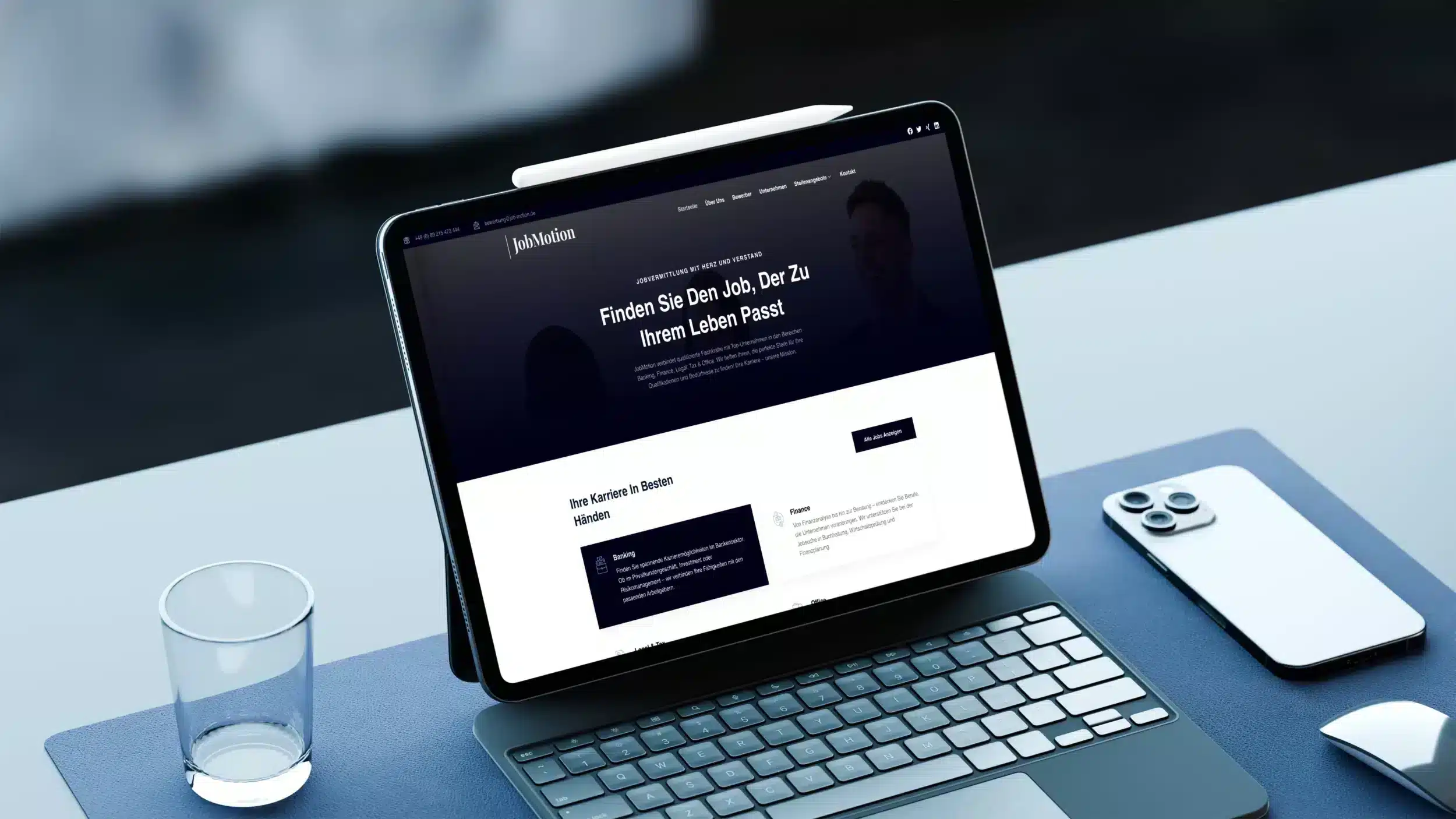
How NKM Digital built JobMotion’s responsive recruitment platform and paired it with personalized LinkedIn outreach to create a stronger flow of candidate enquiries.
JobMotion needed more than a polished recruitment website. The company required a dependable system for publishing vacancies, helping candidates understand its specialist value, accepting applications across devices, and building relationships with professionals who might be ready for a career move.
NKM Digital created that system in two connected layers. First, we designed and developed a responsive WordPress recruitment platform where JobMotion can publish roles and candidates can move from discovery to application. We then supported the website with relationship-first LinkedIn outreach that begins by establishing a genuine connection, identifies whether a professional is considering a job change, and only then introduces a relevant opportunity.
The result is a coordinated acquisition model for both active and passive candidates. The live website provides an owned destination with 44 public job URLs as of 20 October 2026, while LinkedIn expands JobMotion’s network and starts conversations outside the site. According to the client, the fast website and stronger LinkedIn network now generate a steady number of enquiries from candidates interested in switching jobs.
Some candidates actively search for a role, compare vacancies and submit an application. Others are qualified and potentially open to change, but they are not browsing job boards every day. JobMotion needed to reach both groups.
Relying only on a website would limit the business to people already searching. Relying only on outbound messaging would create another problem: generic recruitment messages are easy to ignore and can weaken trust before a meaningful conversation begins.
The commercial challenge therefore had four parts:
The solution had to connect owned infrastructure with relationship-driven outreach.
A recruitment website and LinkedIn solve different parts of the same acquisition problem. The website captures and converts existing intent. LinkedIn helps reveal intent that is not yet visible.
We designed the system around that distinction:
This prevents the two channels from competing with one another. LinkedIn creates awareness and conversation; the website provides proof, detail and a structured next step.
JobMotion required a system its team could continue using as vacancies changed. WordPress provided the content foundation, while Elementor made it practical to maintain page layouts and preserve a consistent brand experience without rebuilding every role from scratch.
The live site now supports a dedicated job content structure, sector pathways, applicant and company information, and direct contact or application actions. LinkedIn was the natural complementary channel because it provides access to professionals by role, industry and career context while allowing the relationship to develop gradually.
The technology and channel decisions were based on workflow:
We created a clean and credible digital experience that presents JobMotion as a specialist partner rather than a generic vacancy board. The website explains its role for both candidates and employers, identifies the sectors it serves, and reinforces a personal, efficient approach to recruitment.
The current message—connecting qualified professionals with top employers across Banking, Finance, Legal & Tax, and Office roles—gives candidates immediate context and makes the value proposition easy to understand.
The website was structured so JobMotion can publish new roles, update existing positions and maintain a growing vacancy library. Each job page provides the role context, responsibilities, candidate profile, location and a direct route to apply or contact the team.
As of 20 October 2026, the public WordPress sitemap lists 44 job URLs. This is observable evidence that the platform functions as an operating recruitment system rather than a static company website.
Job seekers need to assess an opportunity quickly. We designed clear role pages and a simple path from vacancy discovery to application or enquiry. The experience works across conventional phones, tablets and desktops, allowing candidates to respond when interest is highest.
Speed and responsiveness matter commercially. Every unnecessary delay or confusing interaction creates another opportunity for a qualified candidate to postpone or abandon the application.
The website does not speak only to applicants. Dedicated journeys explain how JobMotion supports employers through candidate matching, market knowledge and faster recruitment. This gives the business one coherent platform for both sides of the placement process.
That balance strengthens trust: candidates can see the employer relationships behind the opportunities, while hiring companies can understand JobMotion’s specialist network and recruitment approach.
After the website launched, we began expanding JobMotion’s LinkedIn network. The outreach strategy deliberately avoids opening with a general vacancy pitch.
The first objective is to establish a relevant professional connection. Once that connection exists, the conversation explores whether the person is satisfied in their current role, considering a change or open to hearing about a better-fit opportunity. Only candidates who show genuine interest are moved toward a role conversation.
This approach respects the candidate’s timing and creates a more useful signal than a high volume of untargeted messages.
A job title alone does not reveal whether someone is ready to move. We focused on the intent behind the profile: career stage, openness to change, professional goals and relevance to JobMotion’s current or future vacancies.
That sequencing helps the team avoid forcing an opportunity into the wrong conversation. It also creates a pipeline of professionals who may not apply immediately but can become relevant when the right role appears.
When a candidate expresses interest, the website supports the next step. They can review JobMotion’s positioning, browse relevant vacancies, understand the candidate service and contact or apply through a structured journey.
This connection between channel and platform is important. LinkedIn starts the relationship, but the website provides depth, credibility and continuity outside a social network.
Each relevant connection strengthens JobMotion’s future reach. Even when a person is not ready to change jobs today, the relationship remains part of the company’s professional network. New vacancies, career content and timely follow-up can create opportunities later.
The system therefore produces more than immediate applications. It builds a reusable candidate audience around JobMotion’s specialist markets.
Job opportunities lacked a single, scalable presentation and application system.
A structured recruitment website supports 44 public job URLs and direct candidate actions.
The digital presence did not fully communicate JobMotion’s specialist recruitment value.
Clear candidate, employer and sector journeys establish expertise and trust.
Candidate acquisition depended heavily on people already searching for jobs.
LinkedIn outreach expands reach to professionals who may be open to change but are not actively applying.
Generic outreach risked being ignored before relevance was established.
Connection-first conversations identify interest and career intent before presenting an opportunity.
Website and social activity could operate as disconnected tasks.
LinkedIn creates the conversation; the website supplies proof, vacancies and a structured next step.
Candidate relationships were oriented toward an immediate vacancy.
A growing network creates a reusable audience for current and future roles.
JobMotion now has an owned platform for active candidates and a relationship channel for passive candidates. The website publishes current opportunities, supports applications and explains the company’s value. LinkedIn helps the team build trust, identify job-switch intent and introduce relevant roles at the right time.
According to the client, the combination of the fast-loading website and stronger LinkedIn network is generating a decent number of enquiries from candidates considering a job change. No audited enquiry count or conversion rate was supplied for this case study, so the result is presented as a client-reported outcome rather than an independently verified metric.
The live website provides observable evidence of the operating system: 44 public job URLs, sector-specific pathways, dedicated content for applicants and companies, vacancy details, contact information and application prompts.
This model improves the commercial value of both assets. The website becomes more useful because LinkedIn directs relevant people toward it, and LinkedIn outreach becomes more credible because a professional recruitment platform supports the conversation.
“Nilesh is very professional. He is very reliable. Also he is on time and it’s a pleasure to work with him. His skills are amazing!”
Soheyl Mirshahreza
JobMotion GmbH · Contra review, 18 November 2025
JobMotion demonstrates that recruitment growth is strongest when the website and outreach process are designed as one system.
NKM Digital approached the project through four questions:
Those questions transformed a website build and social-media task into a connected candidate-acquisition strategy.
If your business needs more than website traffic, NKM Digital can connect your platform, content and outreach into one measurable acquisition system—built around the way your audience actually makes decisions.
Results and source note. JobMotion’s live website structure, public job listings, candidate and employer pathways, technology and contact/application journeys were observed on 20 October 2026. The 44-job count reflects URLs listed in the public WordPress job sitemap on that date. The outreach method and reported enquiry flow were supplied by NKM Digital and the client brief; no audited enquiry volume, conversion rate or placement revenue was provided. The client quotation is reproduced from the public Contra review.